You have built a sophisticated agent.
It pulls documentation through RAG, writes code, hits an API, and fails.
The library deprecated a method three months ago, but your vector store still thinks the method is valid.
If you implemented defensive prompting, your agent catches the mismatch. It writes a probe, discovers that the documentation is stale, figures out the correct API signature, and completes the task.
Victory, right?
Not quite.
What happens tomorrow when a different agent gets a similar task?
It retrieves the same stale documentation from your vector database. It fails the same way. It burns the same tokens running the same probe. Eventually, it rediscovers the same correction.
Your agent learned.
Your system forgot.
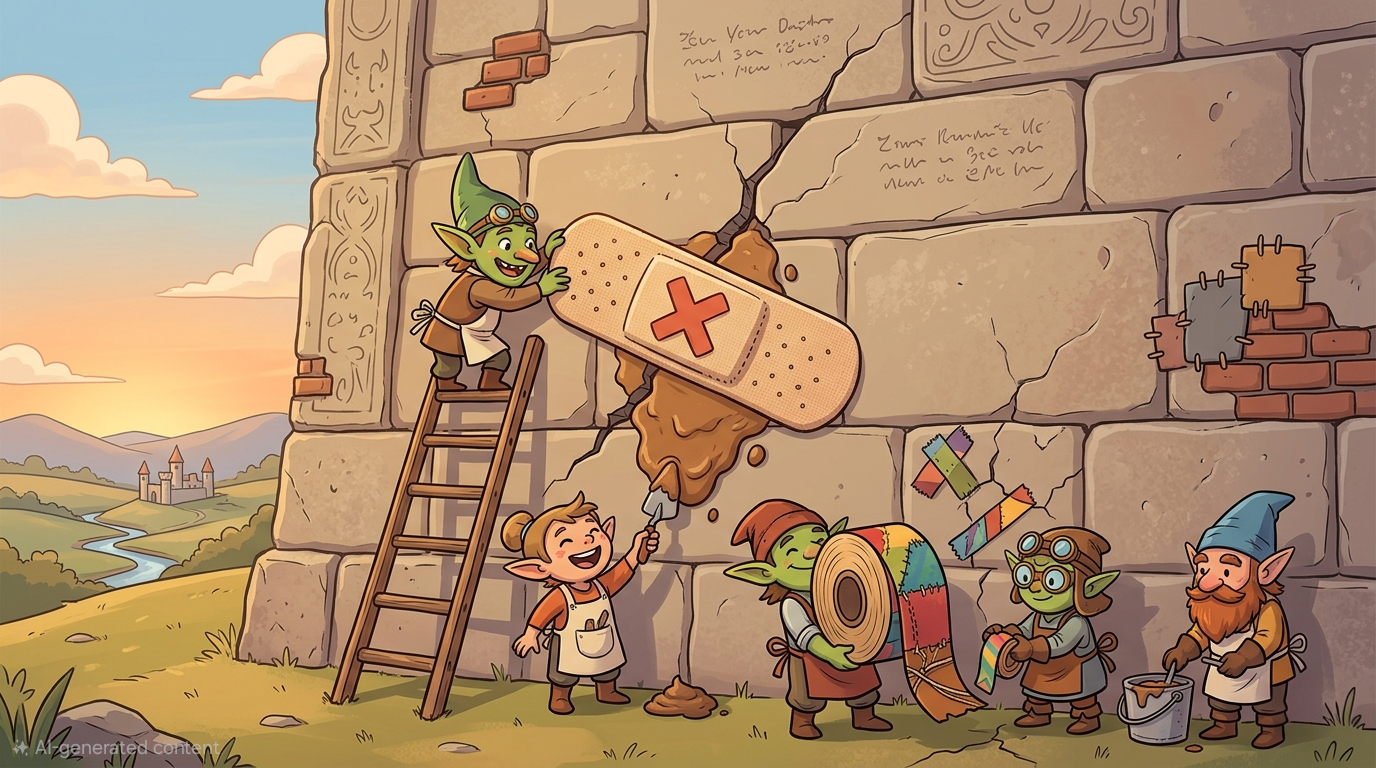
To build compounding intelligence, you have to close the loop. Agents should not only consume context. When they prove that context is wrong, they should be able to patch the retrieval layer for the next run.
That is the idea behind a self-healing vector database.
The Core Architecture: The Errata Store
The tempting move is to let the agent overwrite the original chunk in your vector database.
Do not do that.
Allowing autonomous agents to mutate foundational documentation creates a much worse failure mode: hallucinated overwrites, degraded source data, and no clean way to recover the original context.
Instead, borrow a concept from publishing: an errata store.
You maintain two distinct vector namespaces, or two separate databases:
1. The source of truth. This is your normal RAG database containing scraped docs, internal knowledge, release notes, and other primary material. It is read-only to agents.
2. The errata store. This is a dynamic database containing agent-discovered corrections. It is mapped back to the original source documents and is writable only through a guarded patch workflow.
The source stays intact.
The errata layer accumulates verified corrections.
Step 1: Detect Stale Context
The agent has to know when it has successfully bypassed bad documentation.
That means your execution loop should include an explicit patch instruction.
If you discover that provided documentation is inaccurate or outdated based on
runtime errors, compiler feedback, API probes, or live introspection, output a
<Context_Patch> block before finalizing your response.

The block must include:
- The outdated claim
- The newly discovered ground truth
- The evidence that proves the correction
- The original source URL or chunk ID, if available
The important part is the evidence field.
You do not want the agent patching your retrieval system because it has a hunch. You want it patching the system only when it has a concrete signal: a passing test, a compiler result, a live API response, or an introspection command.
A patch might look like this:
<Context_Patch>
  <SourceChunkId>stripe-docs-create-customer-042</SourceChunkId>
  <OutdatedClaim>The create customer endpoint accepts team_id.</OutdatedClaim>
  <GroundTruth>The endpoint now requires organization_id. team_id is rejected.</GroundTruth>
  <Evidence>A POST request with team_id returned 400. The same request with organization_id returned 200.</Evidence>
</Context_Patch>
Step 2: Intercept and Store the Patch
When your orchestrator detects a <Context_Patch> block, it should not blindly stuff that text into the main index.
It should parse the patch, validate it, embed it, and write it to the errata store with metadata that links it back to the original document.
At minimum, store:
- Original source URL
- Original chunk ID
- Outdated claim
- Corrected claim
- Evidence type
- Agent run ID
- Timestamp
- Confidence score
- Review status
The metadata link is what lets you retrieve the correction alongside the stale chunk later.
Without that link, the errata store becomes another pile of vaguely relevant context.
With that link, it becomes a targeted override system.
Step 3: Retrieve From Both Stores
The next time an agent asks about the same topic, retrieval should query both indexes.
First, retrieve from the source of truth as usual.
Then, retrieve from the errata store using the same query and any source metadata from the first pass.
If an errata chunk is linked to a retrieved source chunk, inject them together.
[Original Documentation]
The endpoint accepts team_id in the request body.

[System Warning: Previous Agent Correction]
On 2026-05-28, an agent verified that this documentation is stale.
The endpoint now requires organization_id. Requests using team_id return 400.
Evidence: live API probe returned 200 after replacing team_id with organization_id.
This is the healing step.
The old document still exists, but future agents no longer read it in isolation. They see the original claim and the verified correction in the same context window.
The agent does not have to rediscover the failure.
The system remembers.
Step 4: Gate Writes With Confidence
A self-healing system also needs restraint.
Most agent discoveries should not become retrieval patches.
Only allow a patch when the correction is tied to successful execution. Good evidence includes:
- A passing compiler or type-check result
- A test suite that failed before the correction and passed after it
- A live API response with a successful status code
- A schema introspection result
- A versioned package export inspection
Failed runs should never patch the database.
Neither should vague explanations like "the docs appear outdated."
The agent has to prove the correction.
Step 5: Add Human Triage
Even with confidence gates, you should assume some patches will be wrong.
Build a small internal dashboard for review.
It does not need to be fancy. It only needs to show recent patches, grouped by source document, with enough evidence for an engineer to approve or reject them.
An approval can do one of two things:
- Keep the correction in the errata store as a trusted override.
- Permanently update the source document and clear the related errata.
A rejection should mark the patch as invalid and prevent similar low-confidence patches from being re-added.
Human review turns the errata store from "agent memory" into a maintenance queue for your knowledge base.
Step 6: Handle Decay
Corrections age too.
If your source docs are stale today, the errata may be right. After the next upstream re-index, the source docs may already contain the correction.
That means errata needs a time-to-live policy.
When you refresh and re-index source material from upstream, expire errata linked to those documents. If a correction still applies, a future run can rediscover it. If it no longer applies, it will not keep overriding fresh context.
For high-change surfaces like SDKs, APIs, and internal schemas, use shorter TTLs.
For slower-moving institutional knowledge, use longer TTLs and rely more on review status.
The rule is simple:
Errata should heal stale context. It should not become stale context.
The Business Impact
A self-healing RAG pipeline changes your unit economics.
Without it, token burn is repetitive.
Every time an API changes, every agent that touches that API pays the same debugging tax: bad retrieval, failed attempt, probe, correction, retry.
With an errata store, you pay that debugging tax once.
The first agent takes the hit, discovers the truth, and writes a verified patch. Every subsequent agent receives the correction on the first pass.
That means:
- Fewer repeated failures
- Lower retry churn
- Less token waste
- Faster successful runs
- Higher trust in agentic workflows
The system gets better precisely because something broke.
Where Ninelayer Fits
Ninelayer is focused on giving agents compact, source-aware evidence from the live web before they act.
But retrieval quality is not only about the first search.
In serious agent systems, retrieval should improve from runtime feedback. If an agent proves that a document is stale, that discovery should become useful context for the next agent.
The healthier loop looks like this:
Search gives the agent a better starting point.
Verification grounds the agent in reality.
The errata store makes the learning compound.
The Practical Takeaway
If your agents can discover stale context but your retrieval layer cannot remember the correction, your system has amnesia.
The fix is not to let agents rewrite your source of truth.
The fix is a separate, guarded errata layer:
- Keep source documents read-only.
- Let agents propose structured context patches.
- Require hard evidence before storing corrections.
- Retrieve errata alongside the original chunks.
- Add review, TTLs, and cleanup.
That is how you move from one clever agent to a system that gets smarter over time.
We are building Ninelayer for teams who want agents to retrieve better context, waste fewer tokens, and make fewer confident mistakes. If that sounds familiar, get started.